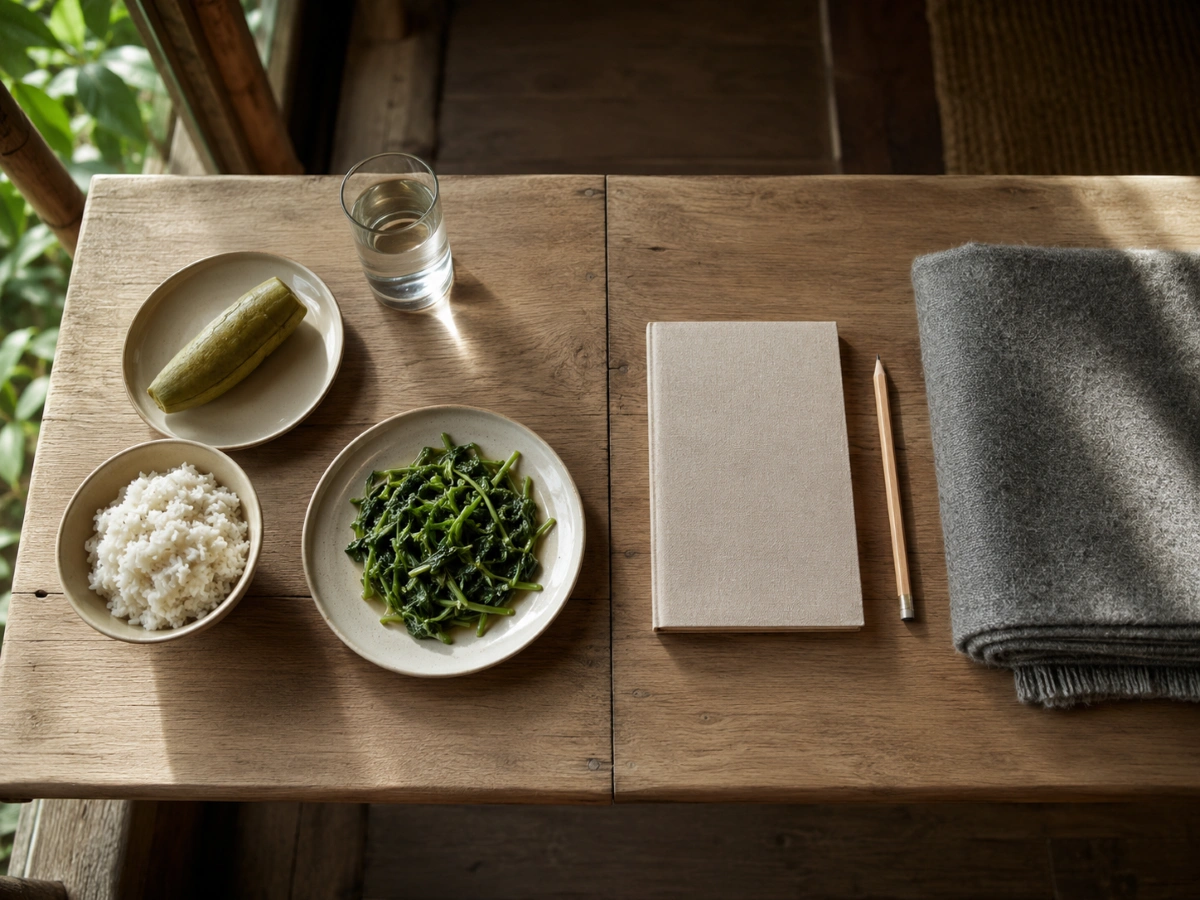
Both matter, and they don’t do the same job.
Physical preparation, meaning the dieta and the medication taper, is what keeps you medically safe and what makes the night easier on your body. Emotional and mental preparation is what decides whether the week still means something 3 months later. The dieta comes with a shopping list, so people do it. Mental prep comes with nothing, so people skip it and hope.
The evidence runs the other way. In a prospective study of 654 people, going in with a settled mind was the single strongest protection against a frightening experience. And the only validated scale for measuring psychedelic preparedness has 4 domains, of which 1 is about your body.
If you have 5 weeks before a retreat, spend 3 of them on food and all 5 on your head.
What is mental preparation for ayahuasca?
Mental preparation for ayahuasca is the work of setting expectations, forming an intention, and arranging support before a ceremony. Unlike the dieta, it has no food list. Research measures it across 4 areas: what you know, what you want, how ready you feel, and who is waiting for you when you get home.
What each kind of prep controls
| Physical prep | Emotional and mental prep | |
|---|---|---|
| What it is | 3-week dieta, medication taper, arriving rested | Expectations, intention, support, planning the week after |
| What it controls | Medical safety, purge severity, whether you’re cleared to drink at all | Whether the night turns frightening, whether anything holds 3 months later |
| Evidence behind it | Strong for medications, thin for most of the food list | 654-person prospective study, 6,877-person survey, 1 validated scale |
| When it starts | 3 weeks out | At the application, about 5 weeks out |
| Comes with a checklist | Yes | No, which is the whole problem |
| How people get it wrong | Tapering too late or too fast | Arriving with a demand instead of an intention |

Why does everyone prepare their body and skip their head?
Because the body comes with a list and the mind doesn’t.
We went through the 5 preparation guides that rank for this topic and counted. The most-cited one gives 247 words to mental and emotional preparation and 697 words to diet, tyramine, medications and physical readiness. That’s 2.8 to 1 against your head, and it rises to 4.1 to 1 once you add the packing and travel sections. All 3 of its tables are about food and drugs.
It gets worse further up. The longest guide in the field runs past 4,000 words and has no mental preparation heading at all. Another one files “emotional alignment” as a subsection inside its chapter on why diet matters, which tells you exactly how the industry ranks the two.
None of those 5 pages cites a single study on preparation. Not one.
The reason isn’t laziness. A food list is easy to write, easy to follow, and easy to feel virtuous about. You can look at your plate and know you’re doing it right. There is no equivalent for “have you thought about what happens if the medicine shows you nothing.” So the industry writes the part it can put in a table, and readers do the part they can measure.
What physical preparation buys you
Three things, and they’re worth having: medical clearance, a gentler purge, and a body that isn’t already depleted when the medicine arrives.
The problem isn’t that the dieta is pointless. It’s that every restriction on the list gets presented with the same urgency, so a reader who learns from experience that eating a banana did nothing quietly stops trusting the whole list, including the part that can put them in hospital. Sorting the list by how much evidence sits behind each item fixes that.
Which medications can hurt you?
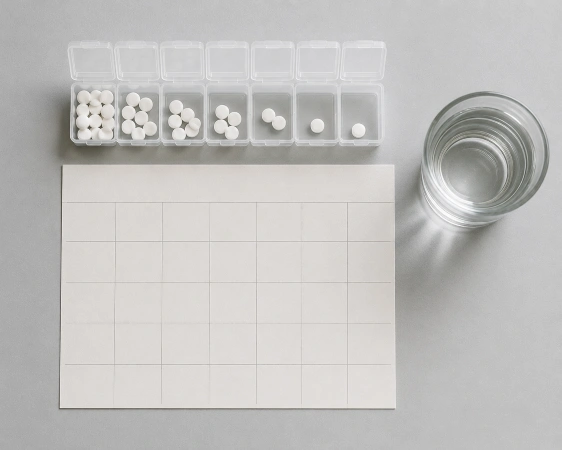
This is the part with real, documented risk, and it’s the part people cut corners on.
The vine’s beta-carboline alkaloids inhibit monoamine oxidase. Serotonergic drugs raise serotonin. Put them together and you can produce a serious reaction. A 2025 scoping review by Tap and colleagues in the Journal of Psychopharmacology, covering 18 studies, found that combining antidepressants with classic psychedelics is broadly safe and doesn’t raise serotonin syndrome risk, then singled out ayahuasca as the exception because of its MAO-inhibiting content. It cites a case in which someone on 20mg fluoxetine developed tremors, sweating, severe vomiting and disorientation after drinking.
So the taper is not optional and it is not something to arrange in the last fortnight. Lithium, tramadol, triptans, stimulants and beta blockers all get read individually. MAOI medication is a full stop with no version of the conversation that ends in yes.
We won’t serve anyone still tapering, however close that taper is to finished, and we say so in writing alongside the combinations we refuse. That’s not caution theatre. Stopping an antidepressant too fast produces dizziness, brain zaps and emotional volatility on its own, and a guest who arrives mid-withdrawal has a destabilised nervous system before the first cup.
Is the tyramine list real?
Partly. Less than the industry implies, and the honest answer is more useful than the scary one.
Here’s what’s true: the beta-carbolines in the caapi vine are reversible MAO-A inhibitors. A 2016 review by Frecska, Bokor and Winkelman in Frontiers in Pharmacology describes them as reversible inhibitors of the A-type enzyme with almost no effect on MAO-B. That word “reversible” is doing a lot of work, because the aged-cheese warnings the whole industry copies were written for irreversible pharmaceutical MAOIs like phenelzine, which behave differently.
Here’s what the evidence shows. A 2024 systematic review by White and colleagues in the Journal of Psychopharmacology screened 2,853 records and included 78 articles on ayahuasca and DMT adverse events. It treats the tyramine interaction as theoretical rather than demonstrated. The one documented instance produced a diastolic rise of 9 mmHg. The same review reports no clear or confirmed cases of serotonin syndrome linked to ayahuasca anywhere in the scientific literature, and concludes that serious adverse effects are rarely reported in healthy populations.
We still run a tyramine-free kitchen and we still send a 3-week list. Not because we think a slice of parmesan will kill you, but because the cost of avoiding it is nothing and the cost of being wrong is a hypertensive event. That’s a reasonable trade. Calling it settled science is not.
Why pork, ice and salt?
Tradition, digestion and comfort. All 3 are good reasons. None of them is pharmacology, and pretending otherwise is how the list loses its authority.
Pork is avoided across Amazonian traditions for reasons that are cultural and energetic, and it’s also fatty and slow to digest, which matters when the last thing you want at 10pm is a working stomach. Salt and spice come off the plate because bland food leaves less to purge. Ice comes off because the tradition says so, and because most guests find it easier to keep everything down without it.
Follow all of it. Know which tier you’re in. A guest who understands that the pork rule is tradition follows it more reliably than one who has been told it’s dangerous and privately suspects it isn’t.
What emotional and mental preparation buys you
A calmer night, and a better chance the week is still doing something in 3 months.
This is where the research is, and almost nobody in this industry reads it.
Haijen and colleagues followed 654 people planning to take a psychedelic on their own initiative, measuring them at 5 points before and after. Their 2018 prospective study in Frontiers in Pharmacology found that a positive set, meaning preparedness, comfort and openness going in, was the strongest protective factor against a challenging experience, F(181)=21.09, p<0.001. Having clear intentions predicted a mystical-type experience, F(181)=6.30, p=0.020. And when the authors compared categories of variable, it was the traits and pre-session measures, not dose, that explained most of the change in wellbeing afterwards.
Ayahuasca-specific data says the same thing at a larger scale. Perkins and colleagues surveyed 6,877 drinkers across more than 40 countries and published the results in Frontiers in Pharmacology in 2021. Higher preparation-activity scores predicted more self-insight, stronger mystical experiences, better current mental health on both the SF-12 and the Kessler-10, and fewer integration difficulties. Of every variable they tested, ratings of support and safety was the only one that predicted every outcome in a beneficial direction.
And the Global Ayahuasca Survey, reanalysed in PLOS Mental Health in 2025 across 5,400 complete records from a pool of 10,836, found that people drinking in non-traditional contexts reported greater increases in every adverse state it measured. The authors put setting, preparation and integration at the centre of what shapes the experience.
None of that is a food list. All of it is your head, your expectations, and the people around you.
The 4 things worth preparing before a 2026 retreat
There’s now a validated instrument for this, which means mental prep can finally be handed to you as a checklist instead of a feeling.
The Psychedelic Preparedness Scale, published in Scientific Reports in 2024 by McAlpine, Blackburne and Kamboj, was built with expert clinicians and experienced users, then validated across 2 online samples of 516 and 716 people and tested prospectively on 46 people before a psilocybin retreat. It has 20 items across 4 factors, with excellent internal consistency at omega 0.954. People who scored high before their experience had greater emotional breakthroughs, better wellbeing, lower challenging-experience ratings, and larger reductions in depression, anxiety and stress afterwards.
Count the factors: Knowledge-Expectations, Intention-Preparation, Psychophysical-Readiness, Support-Planning. One of the 4 is about your body. The field spends roughly 90% of its preparation writing there.
Here’s the same 4 domains, mapped against what a well-run retreat should already be doing and what’s left for you.
| Domain | What it means | What we do | What’s yours to do |
|---|---|---|---|
| Knowledge and expectations | Understanding the effects, holding realistic expectations | We publish an hour-by-hour account of a night and state plainly that roughly 1 guest in 6 has a quiet one | Read the timetable, not the testimonials. Decide now what you’ll do if nothing happens |
| Intention | Clarity of purpose, held loosely | 34 screening questions, then a long first conversation with your integration lead on day 1 | Write it down 3 weeks out. Test it: an intention predicts a better night, a demand predicts a harder one |
| Psychophysical readiness | Body and mind ready to go | 3-week dieta with a grocery list written for US supermarkets, physician-supervised taper, a physician awake on site all 7 nights | The food, the taper, and not booking a red-eye |
| Support and planning | Support systems and practical arrangements in place | Your integration lead calls before you book a flight and stays with you for 12 months after, same person | Tell 1 person. Book the 2 empty days. Line up a therapist before you go, not after |
Knowledge and expectations
Most first-night distress isn’t caused by the medicine. It’s caused by the gap between what someone expected and what arrived.
Guests come having watched a documentary in which somebody meets an entity and comes home rebuilt. Then they lie in the dark for 90 minutes feeling faintly nauseous and conclude they’ve failed at it. We tell people before they book: it can be vivid, or it can be cold, dull and long, and not every night delivers a revelation. The first ceremony is mostly spent learning how to be in the room at all.
Say it out loud to yourself now, in daylight, and it costs you nothing. Discover it at 2am and it costs you the night.
Intention
An intention is a question you’re bringing. A demand is an answer you’ve already decided on.
The Haijen study is specific about this: clear intentions predicted a mystical-type experience, while people arriving with a fixed outcome in mind tended not to get it. Guests who show up wanting a fix tend to leave disappointed, and sometimes worse than they came. That’s not a warning we invented, it’s what we watch happen.
Write yours 3 weeks out, when the dieta starts. Rewrite it in week 2. Bring the version that’s a question.
Psychophysical readiness
This is the one you already knew about, and it’s a quarter of the picture rather than all of it.
Our nutritionist writes a 3-week grocery list laid out for US supermarkets, day by day, and it goes out before you fly. On ceremony days the last meal is at 2pm. The kitchen on site keeps going with the same rules, so there’s no gap between what you did at home and what lands on the table here.
Arriving rested is part of this and gets ignored. The Osa is 3 hours direct from Miami, 4 from Houston, 5 and a half from Los Angeles, at sea level, with drinkable tap water and no vaccination schedule. That matters more than it sounds. Guests flying into the Peruvian Amazon face a connection through Lima, altitude, and often a course of antimalarials, some of which interact with ayahuasca. Take the easy flight and land with something in the tank.
Support and planning
This is the domain with the strongest evidence and the least attention, and it costs almost nothing.
Recall the 2021 survey finding: of everything measured across 6,877 drinkers, support and safety ratings were the only variable to predict every outcome beneficially. Not dose. Not diet. Support.
Three things to arrange before you fly. Tell 1 person who won’t be weird about it, so you have somewhere to put the week afterwards. Find a therapist who has worked with psychedelic integration and book the first session for the week you return, because trying to find one while you’re raw is a bad time to start looking. And leave the 2 days after you land completely empty. Don’t book a Monday meeting.
Our integration lead calls before you book a flight, sits with you on day 1, and calls for 12 months afterwards. You can run through those on your own regardless of where you sit.
Where do the two kinds of prep overlap?
In more places than the neat split suggests, and the overlaps are where things go wrong.
The taper is the clearest one. Coming off an SSRI is a physical decision with an emotional bill attached, and the bill arrives on a schedule nobody plans for. A guest who tapers on the correct timeline arrives level. A guest who compresses it to fit a booking date arrives with brain zaps and a mood that’s been sliding for a fortnight, and then wonders why the first ceremony was so hard. That isn’t the medicine. That’s withdrawal wearing the medicine’s clothes.
Caffeine is a smaller version of the same thing. Coming off coffee cold in the final week gives you headaches and irritability during exactly the days you were meant to be settling. Taper it across the 3 weeks, not the last 3 days.
Sleep sits in both columns too. There’s no separating a rested nervous system from a steady mind, and there’s no fixing either one after a red-eye.
And screening is both at once. A physician reads all 34 answers on every application, and roughly 1 in 5 doesn’t proceed. What’s telling is the shape of the refusals. The physical contraindications get you declined outright, and the full screening lists are published: MAOI medication, diagnosed schizophrenia or bipolar I, uncontrolled hypertension or a cardiac event in the last 12 months, epilepsy, severe liver disease, pregnancy. The psychological ones usually get you deferred instead. An unfinished taper, a recent bereavement, a life in acute crisis. Not no, not yet. Come back when the ground is steadier.

What if nothing happens on the first night?
Roughly 1 guest in 6 has a quiet night with little visible happening. It’s normal, it isn’t failure, and knowing the number in advance is the single most useful piece of mental preparation we can give anyone.
We publish that figure because the alternative is somebody lying in the dark at 2am deciding they’re broken, or that they’ve wasted their money, or that they should ask for more than they can hold. All 3 of those make the night worse than the quiet one they were having.
A quiet night is often the medicine taking your measure. Two maestros work the room, 1 for every 3 guests, and by the second night they’ve adjusted what they sing for you specifically. That’s the argument against one-off ceremonies in a sentence: a single night gives them nothing to adjust from. Guests who report little on night 1 frequently report the most on night 2 or 3.
So decide now. Not at 2am. If nothing happens, you lie there and let nothing happen.
Preparing for the week after you land
Start planning re-entry before you leave, because most of the value is won or lost there.
The 2021 survey measured integration difficulties as an outcome in its own right, and higher preparation scores predicted fewer of them. Preparation, in other words, keeps working after the retreat ends. Most people plan up to the last ceremony and nothing beyond it.
Book the 2 empty days. Don’t schedule anything on the Monday. Expect the first week home to feel strange in a way that’s hard to describe to colleagues, and expect that the strangeness passes. Our integration calls run for 12 months with the same person who sat with you, included in the price, because the week is the smaller half of this.
If you’re arriving with something specific already in play, the shape of your preparation changes. We’ve written separately about what changes after 50, about sitting as a couple, and about coming to this while sober or in recovery, where the mental preparation carries even more of the weight.
One practical note on sequencing, since it comes up. Kambo sits on day 2 as physical preparation, never on a ceremony day and never within 24 hours of one. Bufo, when it’s offered, comes only on the final morning and only when the physician and your integration lead clear you independently. Roughly 3 guests in 4 are never offered it.
Emotional and mental prep versus physical prep isn’t a choice between 2 options. It’s a question of where your attention goes during the 5 weeks you have. Give the food list its 3 weeks. Give your head all 5. If you want to talk through where you are before you decide anything, start with a conversation rather than an application.
Questions people ask before their first ceremony
How long does mental preparation for ayahuasca take?
Longer than the diet. Screening runs about 2 weeks and the dieta runs 3 more, so the real runway is roughly 5 weeks, and mental preparation should start on day 1 of that rather than in the final week. The 2018 prospective study of 654 people found pre-session mindset was the strongest protection against a difficult experience, which means the work you do in week 1 is doing something by week 5.
What makes a good ayahuasca intention?
A good intention is a question you’re carrying. A bad one is an outcome you’ve already decided on. In the 2018 Frontiers in Pharmacology study, having clear intentions predicted a mystical-type experience at p=0.020, while people who arrived demanding a specific result generally didn’t get it. Write yours 3 weeks out and rewrite it once before you fly.
Is mental preparation for ayahuasca more important than the diet?
They do different jobs, so neither replaces the other. The diet and the medication taper control medical safety and how hard the night is on your body. Mental preparation predicts whether the night turns frightening and whether the effects hold months later. The only validated preparedness scale has 4 domains and only 1 is physical, which is a fair guide to how the attention should be split.
What happens if nothing happens during the ceremony?
Roughly 1 guest in 6 has a quiet first night with little visible happening, and it isn’t a failure or a sign the dose was wrong. Two maestros work the room and adjust what they sing per person by the second night, so guests who report little on night 1 often report the most on night 2 or 3. Deciding in advance how you’ll handle a quiet night is one of the more useful things you can do beforehand.
Should I tell my therapist before an ayahuasca retreat?
Yes, and book the first session back before you leave rather than after. In a 2021 international survey of 6,877 ayahuasca drinkers, ratings of support and safety were the only variable that predicted every measured outcome beneficially, ahead of diet and dose. Finding an integration-aware therapist while you’re still raw from the week is a poor time to start looking.
Can you over-prepare, or research it too much?
You can over-research and under-prepare at the same time, and it’s common. Reading 40 trip reports builds expectations rather than readiness, and specific expectations are what make a quiet night feel like a failure. Read how your own center runs a night, write your intention, arrange your support, then stop.
Ask us anything on this page. We answer in writing.
Applications are read by a physician within 48 hours. If the medicine is not right for you now, we will say so.