
Partly. You control 3 things, and not one of them is what happens to you.
You choose whether to drink. You choose how much, inside what the maestros will pour. And you choose where your attention sits for the next 5 hours. That’s the whole list. You don’t control what surfaces, how long it stays, whether you vomit, whether you see anything at all, or whether the night is tender or brutal.
The partial control is the problem. Kambo gives you nothing to steer, so nobody tries. Synthetic 5-MeO-DMT takes the wheel in about 10 seconds. Ayahuasca hands you 5 hours in which control still feels reachable, and people spend those 5 hours reaching. Surrender is what you do instead of reaching.
What surrender means in an ayahuasca ceremony: Surrender is giving up control of the outcome while keeping control of your attention. You stop trying to change what is happening in your body and mind, and you stop predicting where it goes next. You keep breathing, you keep noticing, and you let the night finish its own sentence.
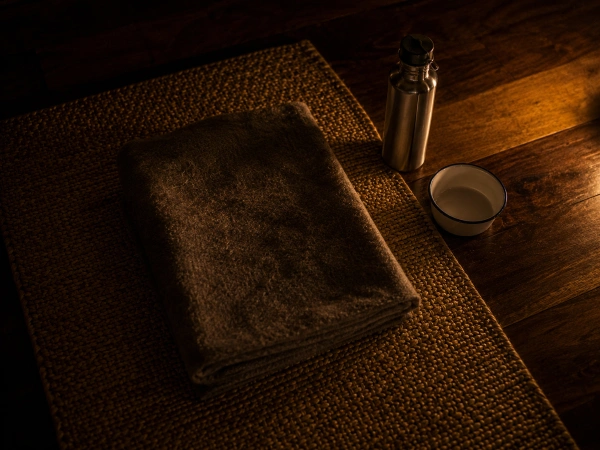
The 3 things you actually control
Three levers, and they are all small and physical. Nobody at our Osa Peninsula centre has ever controlled a ceremony. Plenty of people have controlled these.
Whether you drink. Nobody has to drink. Sit the night out on your mat and listen if you want to. Nobody argues with you, and nothing about the week changes.
Roughly how much. The dose is decided per person and it moves across the week. First-time guests start conservative. You can ask for less. Ask for more and you may be told no.
Where your attention goes. This is the only lever that works during the 4 to 6 hours of altered perception, and it is the one people forget they have. More on it below, because the research says it matters more than the other two combined.
What you do not control: the content. Not the memory that arrives, not the body sensation, not the duration, not the purge, not the meaning. People arrive with a list of things they intend to work on. The medicine reads the list and then works on something else.
What happens when you fight an ayahuasca ceremony?
It gets longer and more physical. Fighting does not shorten a hard passage, it stretches it and moves it into the body.
The pattern is consistent enough that facilitators can spot it from across a dark maloca. Someone tenses. Their breathing goes shallow and high in the chest. They start negotiating, silently, with whatever is arriving. And then the same sensation or image comes back around, a little louder, because nothing has been allowed to move through.
This shows up most around the purge. Guests treat vomiting as evidence that something has gone wrong, so they clamp down on it, which makes it worse and longer. The data says the opposite. In the Global Ayahuasca Survey, published in PLOS Global Public Health, 69.9% of 8,216 people reported acute physical effects, mostly vomiting, and 62.0% reported nausea or vomiting specifically. Vomiting isn’t the exception in this work. Vomiting is what usually happens.
Which reframes the whole thing. If roughly 7 in 10 people vomit, then vomiting is not your body failing at surrender. The ceremony is running normally. The thing worth resisting is the resisting.
Why kambo and bufo are easier to surrender to than ayahuasca
Because neither one offers you the illusion. How the week is ordered sets up 3 different amounts of control on purpose.
| When | How long | Awareness | Control available | Guests who take it | |
|---|---|---|---|---|---|
| Kambo | Day 2, morning | 30 to 45 minutes acute | Fully conscious | Nothing to pretend at | Roughly half |
| Ayahuasca | Nights 3, 4, 6 and 7 | 4 to 6 hours | Altered | Feels available for hours | Everyone. It is the week |
| 5-MeO-DMT | Day 8, morning | 15 to 25 minutes | Gone | None, and you do not choose | Roughly 1 in 4, offered |
Nobody with the kambo application ahead of them believes they can steer it. You chose it, it stings, you are sick for half an hour, it ends, and you are awake the entire time. Call it a rehearsal for surrender with the stakes turned down.
The 5-MeO-DMT session removes even the choice of readiness. It cannot be requested. Two people assess you independently, the physician on how your body handled 4 nights of ceremony and the integration lead on where your head is, and either one can quietly say no. Our page puts it plainly: you cannot talk your way to a yes. The guest who most wants to prove they are ready to let go is exactly the guest that protocol tends to decline.
Then there is four ceremonies across seven nights, sitting in the middle, running 4 to 6 hours in the dark with your mind mostly intact. So that’s the hard one. Not because the medicine is stronger, but because it leaves you enough of yourself to argue with it.
Letting go is only half the instruction
The standard advice is to empty your mind and let go. The best evidence we have says the useful move is more active than that.
A 2022 prospective study by Agin-Liebes and colleagues in the Journal of Psychopharmacology followed 261 people across 3 Shipibo ayahuasca centres, the same tradition our maestros come from, with a 3-month follow-up. Of everything they measured, cognitive reappraisal during ceremony had the strongest moderating effect on gains in positive mood and psychological flexibility. Rises in psychological flexibility then statistically mediated the improvement in mood.
Reappraisal is not emptiness. Reappraisal is reframing. It is the difference between “this is unbearable and it will not stop” and “this is intense and it is moving.” Both are thoughts. One helps.
So the instruction we give is split in two. Give up the outcome. Keep your attention and use it. The goal isn’t to stop thinking. You’re trying to stop fighting the sensation while you change what you’ve decided it means.
Worth naming the limits. That was an observational study, not a randomised trial, and it measured reappraisal rather than the word surrender. It points in a direction. It does not prove a technique.
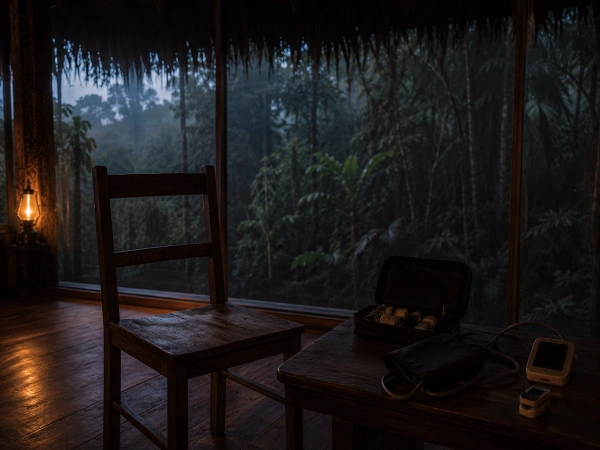
How do you surrender at 2am, while it is happening?
You move your attention into your body and you stop asking how long. Those 2 moves cover most of it.
Here is the actual clock, so you know where 2am sits. Last food at 2pm. Guests arrive at the maloca at 8pm. Individual dosing at 8:30pm, then the lamp goes out. The maestros begin singing icaros around 10pm. Midnight is when purging usually runs. 2am is the long middle, the stretch that is hardest to describe and hardest to sit inside. The closing icaro comes at 5am and the lamp is relit.
At 2am, in the dark, this is what works:
- Put your attention somewhere physical and unglamorous. Your feet. The mat under your hip. The temperature of the air.
- Lengthen the exhale. Don’t do breathwork. Just stop holding it.
- Stop checking the time in your head. Duration questions are control questions wearing a disguise.
- Let the icaro be the thing you follow. The icaro isn’t background music. It’s the maestro working, and following it gives your attention a job that isn’t vigilance.
- Raise your hand. A facilitator will come. Wanting company is not a failure of surrender.
That last one is why the ratio matters. We run one maestro per three guests, with 12 guests maximum, 2 maestros singing each night, and a physician awake on the property until the ceremony closes. Surrender is not purely an act of will. Letting go gets easier in a room where somebody reaches you in 20 seconds.
How do you tell resistance from a medical problem?
By whether the problem is in your experience or in your body. Resistance is psychological and it responds to attention. A medical event is physical, it escalates, and it does not care how well you are breathing.
This distinction is missing from almost every article written about surrender, and it is the one that actually matters. The advice to surrender harder is wrong and potentially dangerous when what is happening is a cardiac event, a serotonin interaction, or an emerging psychotic episode. In the same Global Ayahuasca Survey, 2.3% of respondents said their physical adverse effects needed subsequent medical attention, and 11.9% of those reporting mental health effects afterwards needed help from a healthcare practitioner. Small percentages. Not zero.
Signals that are not resistance, and that a facilitator needs to hear about immediately: chest pain, a racing heart that keeps climbing rather than peaking and settling, difficulty breathing that is mechanical rather than emotional, inability to be reached by voice, or a body temperature that feels wrong. You do not have to work out which is which at 2am. Working that out is the job of the person who is awake.
Most of this is handled long before the maloca. Around 1 in 5 applications are declined or deferred after a 34-question application is read by a licensed physician. The hard stops include MAOI medication, a personal or family history of schizophrenia or bipolar I, uncontrolled hypertension, a cardiac event within the last 12 months, epilepsy, severe liver disease and pregnancy. SSRIs and SNRIs need a supervised taper, and it often takes longer than people expect. Recent bereavement or an acute life crisis can get you deferred rather than declined, which is not the same as being told never.
Age changes what gets checked rather than whether you can come. Cardiac and blood pressure screening tightens, and we go through that in detail for guests over 50.
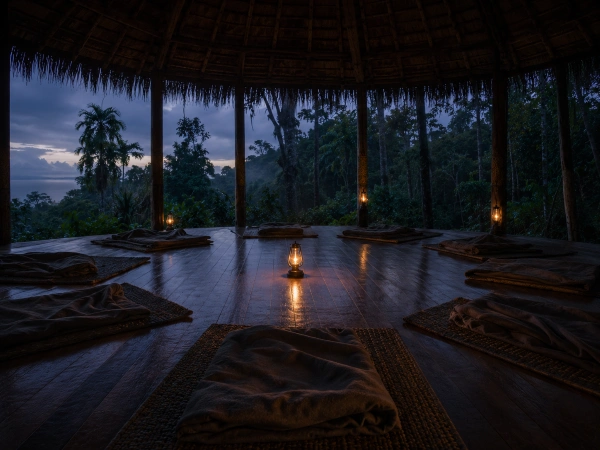
What if nothing happens? Did you resist?
Probably not. Roughly 1 guest in 6 reports quiet nights, with very little visible activity, and it is not a verdict on their character.
This is the question we field more than any other, and almost nobody publishes an honest answer to it. A quiet night looks the same from the outside as a loud one. Someone lies still for 6 hours and decides they have failed, while the person 2 mats over who shook and wept decides they succeeded. Neither read holds up 3 months later.
What tends to be true: a flat first night is common and says very little. Doses shift across the week for exactly this reason. And the maestros are working from real observation of you by the second ceremony, which they do not have on the first. Nights 3 and 4 are introductions in both directions.
Our ayahuasca page says it more bluntly than most centres would: not every night delivers a revelation. Four ceremonies exist because 1 or 2 teach the maestros almost nothing.
Practising surrender before you fly, and the 2026 dieta rules
Preparation does more for your ceremony than anything else on this list, and the research backs the boring version of it rather than the mystical one.
The field’s standard advice is to arrive with no expectations. The largest prospective study on this points the other way. Haijen and colleagues, in Frontiers in Pharmacology, followed 654 people and found that clear intentions were associated with mystical-type experiences, while a positive set, meaning feeling prepared and ready, was associated with fewer challenging experiences. Clear is not the same as rigid. Have a reason for coming. Don’t have a script.
The practical side for 2026 has not changed. The dieta runs 3 weeks before arrival and it is where most people cut corners. Cutting them isn’t a moral failure. It just makes the first 2 nights harder than they needed to be. Tapers are the part with real stakes, because an SSRI or SNRI taper is a medical process with your own prescriber, not a countdown you run yourself.
The rehearsal that helps most is unremarkable: sit still for 15 minutes a day and do not fix anything. No app, no target, no outcome. Notice something uncomfortable, physical or emotional, and stay with it without adjusting it. You’ll need that exact move at 2am, and your own living room is a much cheaper place to learn it.
Surrender never means giving up consent
Surrender applies to the experience, never to your boundaries. You can decline a cup, decline touch, decline a second dose, and leave the maloca with a facilitator, and none of it means you failed at letting go.
This gets muddled constantly, and the muddle is how people get hurt in this field. A ceremony space where “you need to surrender” is used to override a stated no is not a ceremony space, it is a risk. Trust in the maestros and consent about your own body are 2 separate things, and the second one is never the price of the first.
The same line applies to other people’s nights. You are not responsible for managing anyone else’s experience, which is worth reading properly if you are one of the couples who come together.
What we tell the people who most want to stay in control
That the wanting is information, and it is usually the most useful thing they bring.
The guests who most want to control a ceremony are rarely arrogant. They are usually people for whom control has been load-bearing. Control kept a household running, or a diagnosis managed, or a career intact, or a body sober. Being told to hand it over for 5 hours is not a small ask, and pretending otherwise is how centres end up with people white-knuckling 4 nights.
Control is a loaded word for anyone whose recovery depends on it, and that deserves its own conversation rather than a slogan, which is why we wrote separately for people already in recovery.
What we actually say: we’re not asking you to become someone who doesn’t need control. We’re asking you to put it down for 4 nights, in a room with 2 maestros, 12 guests and a doctor who is awake, then pick it back up in the morning if you still want it. Most people find they want less of it than they arrived with. The medicine hasn’t taken anything. That is 5 hours of evidence that the grip was heavier than the thing it was holding.
If you are working out whether any of this fits you, ask before you apply. Talking yourself into readiness is the one form of control we’d rather you didn’t practise.
What people ask about control and surrender
Can you control an ayahuasca experience if you have a strong intention?
No. A clear intention shapes what you bring, not what arrives. Haijen and colleagues found clear intentions were associated with mystical-type experiences across 654 people, but the study measured association, not steering. Bring a reason. Don’t bring a plan for the night.
What does it mean to surrender to ayahuasca?
It means releasing control of the outcome while keeping control of your attention. You stop trying to change what is happening and stop predicting where it goes. You keep breathing and let the ceremony complete its own arc, which usually takes 4 to 6 hours.
Does resisting ayahuasca ruin the ceremony?
Resisting doesn’t ruin it, but it does tend to make hard passages longer and more physical. Resistance shows up as held breath, tension and the same sensation circling back. Softening the breath and moving attention into the body is generally enough to let it move again.
Is it normal to vomit, or does that mean I failed to surrender?
Normal, and common. The Global Ayahuasca Survey found 69.9% of 8,216 people reported acute physical effects, mostly vomiting, and 62.0% reported nausea or vomiting. Purging is the majority experience, not a sign you did something wrong.
What if I feel nothing during my first ceremony?
About 1 guest in 6 reports quiet nights with very little visible activity. A flat first ceremony is common and tells you very little. The dose is set per person and adjusts across the week, and the maestros only have real observation of you from the second night onward.
Can I refuse a dose and still be surrendering?
Yes. Declining a cup, declining a second dose, declining touch, or sitting a night out are all inside the process, not outside it. Surrender applies to the experience. It never applies to consent, and nobody at this centre will tell you otherwise.
Is 5-MeO-DMT easier to surrender to than ayahuasca?
Easier in the sense that it gives you nothing to negotiate with. It lasts 15 to 25 minutes and awareness goes almost immediately. Roughly 1 in 4 guests are offered it. Nobody can request it, and it needs 2 independent approvals, so readiness isn’t a decision the guest makes.
Ask us anything on this page. We answer in writing.
Applications are read by a physician within 48 hours. If the medicine is not right for you now, we will say so.