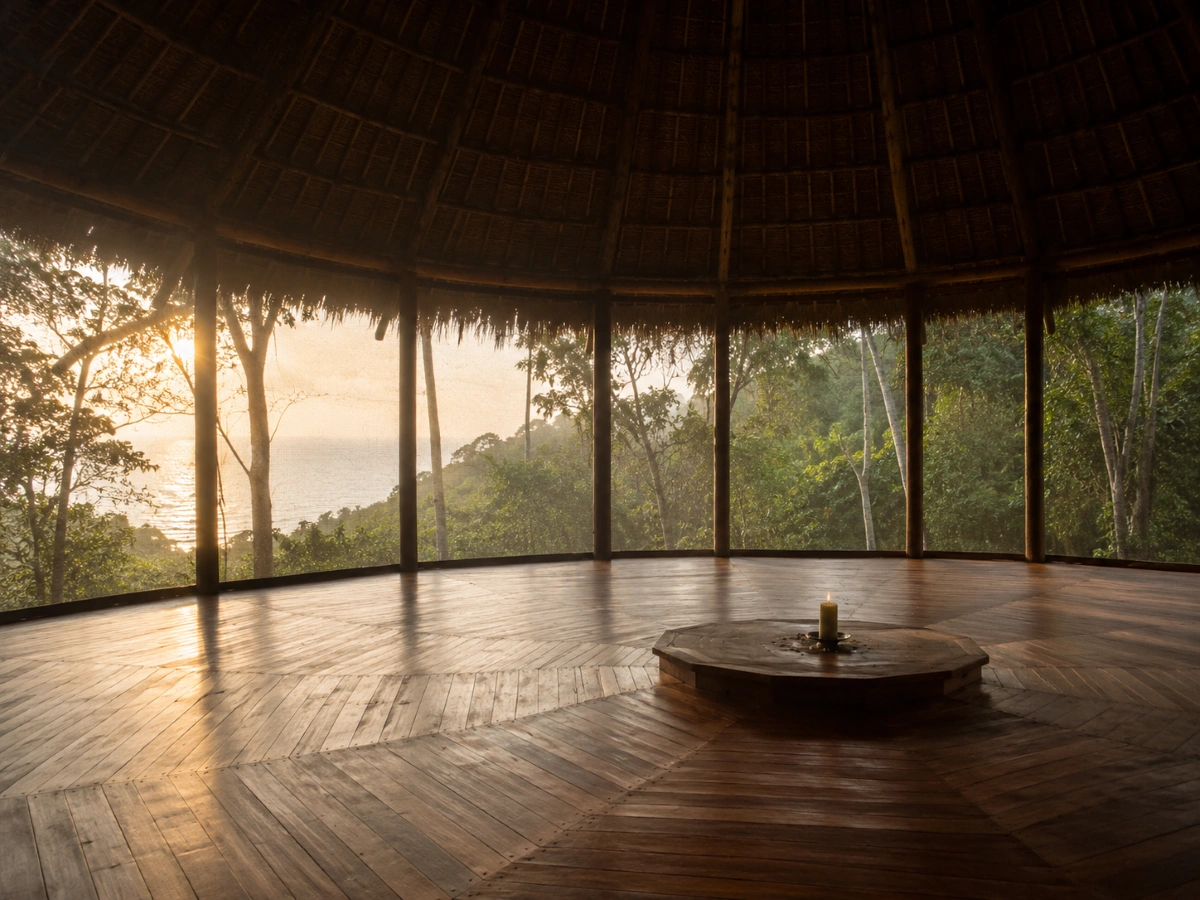
Returning to work after an ayahuasca retreat needs 3 full days at home between landing and your first day back, and 5 if your job involves decisions other people depend on. That’s on top of the retreat itself. Most people book 10 days for the retreat, add travel, and try to walk into the office the next morning. It’s the single most common scheduling mistake we see, and it costs more than the extra leave would have.
The reason is timing. In the Global Ayahuasca Survey of 10,836 people who drink ayahuasca, 55.9% reported adverse mental health effects in the weeks afterward, and for most of them the difficulty lasted under a week. That week lands exactly where your first day back does.
But the harder problem isn’t the first week. It’s week 4, and almost nobody warns you about it.
What returning to work after an ayahuasca retreat involves
Returning to work after an ayahuasca retreat means managing 3 things at once: a body still recovering, a nervous system that has been in silence for 10 days and is now taking notifications again, and a set of insights about your job that may or may not be worth acting on.
The scheduling problem is easy. The last part takes months.
How much time off do you actually need?
Between 12 and 15 days total, depending on your role. Here’s how that breaks down for a 10-day retreat.
The retreat itself is 10 days. Travel adds 1 to 2 days each way for most guests, and we ask people to arrive in Costa Rica a full day early because guests who fly in overnight and go straight into preparation have rougher first ceremonies almost every time. So you are already at 12 to 14 days before you add anything on the back end.
Then add 3 to 5 working days at home before you return. Not travel days. Days at home, in your own bed, with nothing scheduled.
| Type of work | Days at home before returning | Why |
|---|---|---|
| Desk work, flexible deadlines, low stakes if you are slow for a week | 2 to 3 | Sleep debt and appetite normalize in this window for most guests |
| Client-facing, managing people, presenting, negotiating | 3 to 5 | Emotional range stays wide for weeks. Reading a room is easy. Regulating in one is not. |
| Safety-sensitive: driving, machinery, clinical care, aviation, trades | 5 minimum, and clear it with your own doctor | Sleep disruption and slower reaction time are common for several days |
| Shift work or nights | 5 to 7 | Circadian disruption from the retreat schedule stacks on top of shift rotation |
If you can only take 1 day, take it on the far side of a weekend so you get 3. Land on a Friday, not a Sunday.
Add a day or two to every row above if you are drinking after 50, where recovery from the physical side of ceremony reliably takes longer.
Why week 4 back at work is the one to protect
Week 1 back is usually fine, and that’s the trap. You come home with momentum, people say you look well, and you conclude the hard part is over. Around week 3 or 4 the momentum runs out, the retreat starts to feel like something that happened to a different person, and the job you left is still exactly the job you left.
This is the point where our own numbers move in the wrong direction, and it’s the most useful thing I can tell you.
Across 280 guests with complete screening data at intake, day 10, and 3 months, 15% improve and then partly slide back. When we look at who, the pattern is not psychiatric. It’s environmental. It’s guests who went back into a high-stress job with no ongoing support and nothing changed about the conditions they left.
Put plainly: the most common thing that undoes an ayahuasca retreat is going back to work exactly the way you did before.
So the leave you should be protecting is not the week after you land. It’s the capacity to change something at week 4, when you finally see what needs changing and have no energy left to do it.
What we now tell guests to arrange before they fly out: block week 4 as lightly as you can. No launches, no travel, no performance reviews if you can help it. If you have a therapist, book the appointment for week 4 before you leave for Costa Rica, because you will not book it once you’re in it.
What our 2026 outcome data says about high-stress work
We started standardized screening in 2020 because I’d watched guests leave in good shape and come apart 5 weeks later, and I had no way to know whether that was rare or normal. Every guest now completes the PHQ-9 for depression and the PCL-5 for PTSD at intake, on day 10, and again at 3 months. 280 people have completed all three.
The headline: average PHQ-9 fell from 12.8 at intake, in the moderate band on Kroenke’s standard scoring, to 6.4 on day 10, to 7.0 at 3 months. A 5.8-point drop that held.
Among the roughly 24% of guests scoring above the PTSD threshold at intake, average PCL-5 went from 48.1 to 34.6. The National Center for PTSD treats a score of 31 to 33 as probable PTSD and a 10-point change as a response. Our 13.5-point average drop clears that, and 65% of those guests fell below the cutoff. The group average, at 34.6, is still sitting on the line. We publish both halves.
Now the number our industry doesn’t print.
27% of our guests show no meaningful improvement in depression at 3 months. 14% show no change at all, and the 15% partial reversal above makes up the rest.
I publish it because of what it does to a person at their desk in week 5. If every page you’ve read says transformation is the normal outcome, and you’re back at work feeling roughly how you felt in June, you conclude something is wrong with you. It’s roughly 1 in 4 people. Knowing that in advance is the difference between a flat month and a spiral.
One caveat that cuts against us: our 3-month survey response rate is 62%, and people doing well are likely more willing to answer. This is observational data from one center, not a trial.
Should you tell your employer?
Usually no, and there are 3 clear exceptions.
For most people this is a private medical and personal matter, and “I took annual leave” is a complete answer. You are not obliged to describe what you did on holiday.
The exceptions, where the calculation changes:
You hold a security clearance or a role with a self-reporting obligation. Ayahuasca sits in a legal grey area in Costa Rica, where the plants and DMT are not on the controlled substances schedules, but it is illegal in most guests’ home countries. If your clearance paperwork requires you to report drug use, non-disclosure is its own offence, and that’s a question for a lawyer in your jurisdiction before you book, not after you land.
You are asking for accommodation. If you need a lighter week 4, you’ll get further with your manager describing what you need than explaining why. “I’m coming back from leave and want a slow first fortnight” works. It’s also true.
Your role is safety-sensitive and you are not certain you’re fit for it. In that case the conversation is with your doctor first, and any conversation with your employer follows from what they say.
One more thing worth naming. A lot of guests come home wanting to tell everyone. That impulse fades, and disclosures made in week 2 don’t. Choose carefully who you tell at work, not out of shame, but because your colleagues do not have the context to receive it and their confusion becomes your problem.

Does ayahuasca show up on a workplace drug test?
Not on a standard panel. The authorized federal workplace testing panel covers marijuana metabolite, cocaine metabolite, opioids including fentanyl, PCP, and amphetamines including MDMA. DMT and the harmala alkaloids in the vine are not on it, and neither is any hallucinogen except PCP. Most private employer panels follow the same list.
Three things to understand before you treat that as a green light.
Specialized assays for DMT exist and can be ordered. A standard panel is not a guarantee, it’s a description of what most employers happen to test for.
If your job is safety-sensitive, the detection question and the fitness question are not the same question. Whether a test finds something has no bearing on whether you’re fit to fly a plane or run an anaesthetic list 3 days after a ceremony. Answer the second question honestly and the first stops mattering.
For licensed professionals, the real exposure is almost never the urine cup. It’s licensing boards, self-disclosure clauses, and professional conduct rules. Physicians, nurses, pilots, commercial drivers, lawyers, and anyone holding a clearance should get advice from a lawyer or a professional defence organisation in their own jurisdiction before booking. We say this to guests on the screening call, and it’s the single most common thing professionals have not thought about.

What to do about the urge to quit your job
Write it down, date it, and do nothing for 90 days.
This is the most predictable post-retreat impulse there is. “I left a job that was killing me” is one of the most common things guests report at 6 and 12 months, so I’m not telling you the impulse is wrong. I’m telling you week 2 is a bad time to judge it.
The evidence on timing is worth knowing. The only randomized placebo-controlled trial of ayahuasca for depression measured its outcome 7 days after dosing. That 2019 study in Psychological Medicine by Palhano-Fontes and colleagues found 64% of the ayahuasca group responding at day 7 against 27% on placebo, in 29 patients with treatment-resistant depression. Then it ended. Day 7.
Longer observational work, like the 2020 Scientific Reports follow-up by Jimenez-Garrido and colleagues, suggests effects can hold at 6 months, but that study had 15 people left in its final follow-up and no control group. Nobody, including us, can tell you from trial evidence what your judgement will be worth in week 4.
So use a rule instead. Write down exactly what you want to change and why, on the flight home. Read it at 30 days and again at 90. If it still reads as true and specific after 90 days, it probably is. The resignations that go badly in our follow-up calls are almost always the ones made from urgency in the first fortnight.
A case, with permission and details changed. A corporate attorney in her 40s came to us in 2024 with severe anxiety, insomnia, and what she wrote on her intake form as functioning alcoholism. PHQ-9 of 16. She did not quit. At 6 months she’d stopped drinking, was sleeping 7 hours, had taken a leave of absence rather than resigning, and her PHQ-9 was 5. At 12 months she was back at the same firm in a less demanding practice area, running 3 mornings a week. Her summary of it: the medicine showed her the weight was there, and therapy, her marriage, and the running is where she put it down.
She changed her job. It took her 12 months and it wasn’t the decision she wanted to make in week 2.
When leaving the job is the right call
Sometimes it is, and telling everyone to wait 90 days without saying that would be dishonest.
The signals we see in guests whose departures worked out: the problem was named clearly before the retreat, not discovered in ceremony. The job was damaging their health in ways a doctor had already commented on. They left to something, not just away from something. And they made the decision after week 8, with at least one person who knew them well agreeing it was sound.
The signals in the ones that went badly: the decision arrived as a certainty in the first fortnight. Nobody in their life was consulted, which is its own signal and one reason sitting together as a couple changes the shape of these decisions. There was no financial plan. And the job was standing in for something else, usually a relationship or an unaddressed grief, which then followed them into the next job.
There is a version of this that looks like insight and functions as avoidance. Quitting is a large, dramatic action that produces a feeling of change without requiring any of the daily work that produces actual change. Our records are clear that the guests who improve are the ones who make 1 concrete external change within 3 months. Quitting can be that change. Serial quitting is not.
What if you cannot take a week off?
Take what you can, protect week 4 instead of week 1, and change 1 thing about your working day.
Not everyone has paid leave. Contractors, hourly workers, people with 10 days of annual leave total, single parents. If the retreat used all of it, here’s what we tell guests in that position.
Land on a Friday if the flights allow it. Two days is not 5, but it’s not zero.
Cut alcohol for a minimum of 2 weeks, which also means the work drinks. This is the single most common thing that reverses the first month, and it is usually social rather than personal. The calculation is different again for guests arriving sober or in recovery, where the office culture around drinking is often the whole problem.
Protect sleep over everything else, including exercise and diet. Vivid dreams and broken sleep are normal for weeks after a retreat, and the compounding effect of that on a full workload is what actually degrades your first month.
Change 1 small structural thing about the day. A real lunch break away from a screen. A walk before the first meeting. Not checking email before 8am. It sounds trivial next to a 10-day retreat in Costa Rica. In our follow-up calls, the guests who report the most durable change at 6 months are more often the ones who altered one daily habit than the ones who made a dramatic move.
And use whatever aftercare your center provides. Our program in Costa Rica runs a call at week 1, another at week 3, then check-ins at months 2, 6, and 12, plus a support line that doesn’t expire. 85% of guests take the week 1 call and about 40% are still engaging by month 6, which is fine. If your center stopped answering after checkout, that tells you something about the center, and you should find a therapist who understands this work instead.
When returning to work after an ayahuasca retreat is a medical question
Do not go back to work if you are not sleeping, if symptoms are worse than before the retreat, or if you cannot follow a conversation. Get assessed instead.
This is the section most retreat sites leave out, so here’s the line we use with guests.
| When | Normal, go back to work | Get assessed before you go back |
|---|---|---|
| Days 1 to 7 | Tiredness, vivid dreams, tearfulness, sensitivity to noise and screens, appetite changes | Chest pain, fainting, fever, or confusion that does not clear after sleep |
| Weeks 2 to 4 | Wide emotional range, a flat stretch, old memories surfacing, feeling out of step at work | Recurring panic attacks, several nights without sleep, drinking or using more than before the retreat |
| Weeks 5 to 12 | The retreat feeling distant, friction with colleagues, doubting it worked, no clear change yet | Persistent dissociation, symptoms worse than at intake, inability to do your job, any thought of self-harm |
Some scale on the risk. A 2023 study in PLOS ONE by Evans and colleagues surveyed 608 people reporting extended difficulties after psychedelic use, with ayahuasca accounting for 10% of the sample. Within that group, problems persisted beyond a year for about a third and 18.8% received a mental illness diagnosis afterward. That study only recruited people already reporting difficulty, so it is not a rate, it’s a description of the hard end. Even there, 89.7% still said the insights were worth the risk.
Against that, the broader picture from the 10,836-person survey: 88% of people reporting adverse mental health effects saw them as part of a process of growth, and 12% sought professional support. That 12% is not a failure statistic. Getting help is the correct response.
Across 8 years and roughly 1,800 guests, 10 to 15 people have contacted our support line in genuine post-retreat crisis. All resolved with more support. None required psychiatric hospitalization. It’s a small number and it isn’t zero, and any center quoting you zero is either very new or not counting.
In the United States, the 988 Suicide and Crisis Lifeline takes calls and texts at any hour. Elsewhere, your national crisis line. A ceremony experience is not a reason to delay clinical care.
What we tell every guest on day 9
On the last full day of every retreat, before anyone flies home, we run a departure session. Most of it is about work, because most of our guests have jobs and that’s where the retreat gets tested.
The short version: you’ll feel good for about 2 weeks, harder for about a month, then something more durable. Roughly 1 in 4 of you won’t see a measurable change at 3 months. If that’s you, it doesn’t mean the retreat failed and it doesn’t mean you did.
I say it partly from my own side of it. Before this center existed I ran a marketing agency on 4 hours of sleep, and I first drank in Putumayo in 2014, 3 months after my brother died. What changed my working life wasn’t one night. It was 7 trips over 2 years and then rebuilding the business so it could run without me on every call. The ceremony showed me what I was doing. The restructuring took years and happened at a desk.
Taita Lorenzo puts the same thing in fewer words. The vine opens the door. You still have to walk through it, and the door mostly opens onto a Tuesday.
Returning to work after an ayahuasca retreat is not a scheduling problem with a clean answer, though 3 to 5 days at home is the right place to start. It’s a year of small decisions made by someone who can now see what they are choosing, most of them made in an ordinary office on an ordinary morning.
If you sat with us and week 4 is going badly, write to us directly. The support line is included in the retreat fee and it doesn’t expire. If you’re still choosing a center, ask what happens when you’re returning to work after an ayahuasca retreat and week 4 arrives, before you ask about anything else. Then look at how we run ceremonies and the center we built around that answer.
Medical disclaimer: this article is general information from a retreat operator, reviewed by a physician. It is not medical advice, diagnosis, or treatment, and it does not replace care from your own doctor, prescriber, or therapist. It is not legal advice on employment, licensing, or clearance obligations. Ayahuasca carries real medical and psychiatric risk, including dangerous interactions with common medications. Speak to a qualified clinician about your own situation, and a lawyer in your jurisdiction about disclosure obligations in your profession.
Frequently asked questions
How long should I take off work after an ayahuasca retreat?
Plan 3 full days at home after you land, and 5 if your work is client-facing or safety-sensitive. That is on top of the retreat and travel, so a 10-day retreat realistically means 12 to 15 days away from work. In the Global Ayahuasca Survey of 10,836 drinkers, 55.9% reported adverse mental health effects afterward, and for most of them the difficulty lasted under a week, which is exactly the window your first day back falls into.
Can I go back to work the day after an ayahuasca ceremony?
Physically, most people can. It is still a poor idea, and it is a bad idea outright if your work is safety-sensitive. Sleep disruption, slower reaction time, and a wide emotional range are common for several days, and the guests who return straight to a full workload are over-represented in the 15% of our cases whose improvement partly reverses by month 3.
Does ayahuasca show up on a workplace drug test?
Not on a standard panel. The authorized federal workplace testing panel covers marijuana, cocaine, opioids, PCP, and amphetamines including MDMA. DMT and the harmala alkaloids in the vine are not on it, and most private employer panels follow the same list. Specialized assays do exist and can be ordered, and if your role is safety-sensitive the fitness question matters more than the detection question.
Should I tell my employer about my ayahuasca retreat?
Usually not. For most people it is a private matter and “annual leave” is a complete answer. The exceptions are if you hold a security clearance or a role with a self-reporting obligation, if you need a formal accommodation, or if your job is safety-sensitive and you are unsure you are fit for it. For clearance and licensing situations, speak to a lawyer in your jurisdiction before you book.
Why do I want to quit my job after an ayahuasca retreat?
Because the medicine tends to make visible what you were already tolerating, and a job is usually the largest thing on that list. The impulse is common and it is often pointing at something real. Write it down and give it 90 days. The resignations that go badly in our follow-up calls are almost always made from urgency in the first fortnight, and 1 concrete external change within 3 months predicts good outcomes better than a fast dramatic one.
Is it normal to feel worse at work a month after a retreat?
Yes, and week 3 to 4 is the most common time for it. The momentum of the first fortnight runs out, the retreat starts to feel distant, and the job you left is unchanged. In our screening data, 15% of guests improve and then partly slide back, and that group is concentrated among people who returned to high-stress work with no ongoing support.
Will ayahuasca affect my ability to concentrate at work?
For most people, for a few days to a couple of weeks. Broken sleep and vivid dreams are the usual cause rather than any direct cognitive effect, which is why protecting sleep matters more than any other single thing in your first fortnight back. If concentration is still impaired past 3 to 4 weeks, or getting worse rather than better, that is a reason to see a clinician rather than push through.
Ask us anything on this page. We answer in writing.
Applications are read by a physician within 48 hours. If the medicine is not right for you now, we will say so.